
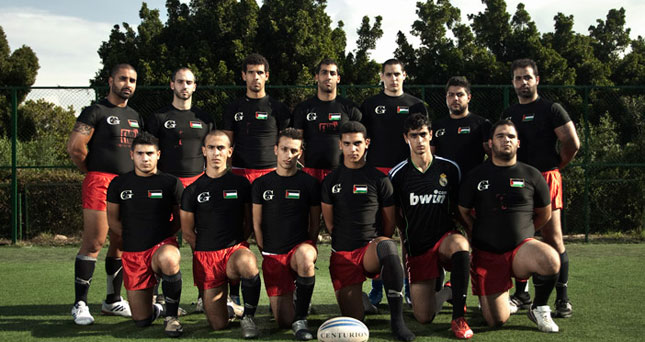
In February of this year, after leaving New York and moving to Beirut, I received an invitation to attend a rugby league match in Beirut between the American University of Beirut team and a Palestinian team. While I was unable to attend the match, I did read about its success in an online article. Upon reading the article, I learned that despite so many obstacles and challenges, Rabie el Masri, a Palestinian athlete born and raised in Lebanon, had successfully started the Palestinian rugby league in Lebanon.
The article caught my attention, as I was working on starting a non-profit organization called “The Nawaya Network†which aims to help underprivileged and marginalized youth in Lebanon access the resources they need to develop their talents and skills. From my experience working with youth across Lebanon, I have discovered that there is so much potential amongst underprivileged youth, but that it often goes unnoticed or is suppressed due to a lack of resources.
I kept Rabie’s story in mind, and in June - upon planning for my short documentary film on my NGO - I decided to contact him to see if he would be available for an interview. I was able to find him on Facebook and received a response from him informing me that he was in France. We ended up chatting via Skype a few days later, and I told him a little more about my NGO plans. He immediately mentioned to me that there are so many talented young Palestinian rugby league players whom he and his brother, Ahmad, have met and trained, and he expressed great support for my idea.
Specifically, Rabie told me about two promising young rugby league athletes from the refugee camps who have been invited to train for two weeks with the professional rugby league club, Hull FC, in England. He explained that these two young men, Samir and Khalid, have an opportunity of a lifetime – to train with other young professionals. I was so amazed and excited to hear about this opportunity… but then Rabie told me that there was one major obstacle: money. They were lacking the funds to cover the cost of the two roundtrip tickets. Besides visas, this was the only issue preventing Samir and Khalid, two extremely talented and promising young men, from going to England.
I responded by telling Rabie that it would be a shame if their passion and their dreams were to be suppressed and cut short simply because of the ticket expenses. I told him that I would work on trying to find some sponsors, as this was very much in line with the goals and objectives of my NGO.
And so, after gathering all the information, I decided to reach out to my network of friends and relatives. I drafted an email to about 35 people, explaining to them that this year, a highly talented young player born in Gaza named Ali Ibrahim, also on Hull FC’s books after his family emigrated to the north of England when he was 3, was selected to play for England’s under-16 national team.
Virtually immediately after sending the email, a deluge of responses flooded my inbox with friends and relatives expressing encouragement for this initiative. I was overwhelmed by the support I received from so many people – even some of whom I have never met. In less than 24 hours, an American friend of mine informed me that her grandmother in the U.S. would like to cover the cost of one roundtrip ticket. I was ecstatic! Over the next couple of weeks, six other people came forward to donate between $50-$250. With their generous contributions, I had raised a total of $785 for the second ticket and excitedly informed Rabie that we had raised the full cost of the two roundtrip tickets.
In the days that followed, I went to meet Ahmad el Masri (Rabie’s brother and the coach of Samir and Khalid). He introduced me to the boys and I watched them practicing in Ramlet Baida, Beirut’s only public beach. I was informed that since they do not have a place to practice, their only option was on the sand. It amazed me that despite the intense difficulty of running on the sand, and the likelihood of getting sand in their eyes and mouths, they were playing extremely well and I clearly saw that these two young men have incredible athletic abilities. I then realized that these young men are building great stamina and endurance by practicing on the sand – and that, ironically, this could very well be one of the reasons they excel in comparison to other more privileged players who may train on normal rugby fields.
I interviewed Samir and Khalid that evening, and learned that they began playing rugby league only two years ago. I thought to myself, it is clearly not easy for 17 and 18 year-olds to develop such great athletic skill within a short period of time. I began to think that they must have had this ability and potential within them, but it took excellent coaches such as Ahmad and Rabie to reveal it and to develop it further. How many others like Samir and Khalid are dwelling in the refugee camps of Lebanon – waiting to be noticed, and waiting to be given the chance to show their hidden potential
In the near future, Samir and Khalid will hopefully be boarding a flight to London to experience the opportunity of a lifetime. What is of such great importance is the fact that they will get this opportunity at all. They will be returning to the refugee camps as champions of Palestine and of all marginalized people – encouraging the youth around them that with hard work and with the right resources, they will be noticed, and they can go places they never dreamed.
The remaining obstacle for Samir and Khalid is their visa. I truly do hope that they will be given the chance to fly – toward their dreams and to experience what they once thought impossible.
To stay updated about Samir and Khalid, and other similar stories, please email ‘The Nawaya Network’ at nawayanetwork@gmail.com

September 16, 2011
-
One Lebanon
-
-
One Lebanon
-
-
One Lebanon
-
-
One Lebanon
-
-
One Lebanon
-
-
One Lebanon
-
-
One Lebanon
-
-
One Lebanon
-
-
One Lebanon
-
-
One Lebanon
-
-
One Lebanon
-
-
One Lebanon
-
-
One Lebanon
-
-
One Lebanon
-
-
One Lebanon
-